Your three-year-old runs over with a page covered in purple swirls and holds it up to your face. You say "Good job!" because it is kind and quick, and you are halfway through making dinner. There is nothing wrong with that. But there is a lot more you can say, and some of it opens up a real conversation about what they made and how they made it. This article gives you phrases you can use straight away, along with a few things that are better left unsaid.
Why go beyond 'good job'
"Good job" is a verdict. It tells your child you approve, and then the conversation is over. Young children often draw for the fun of moving a crayon, mixing colors or covering a page, not to make something that looks good to adults. Talking about what they did, rather than judging how it looks, keeps the focus on the part they actually enjoyed.
It also gives them words. When you say "You made lots of round shapes," your child hears the word round and connects it to something they drew. Over time, that kind of talk gives them more ways to describe their own work.
Describe what you see
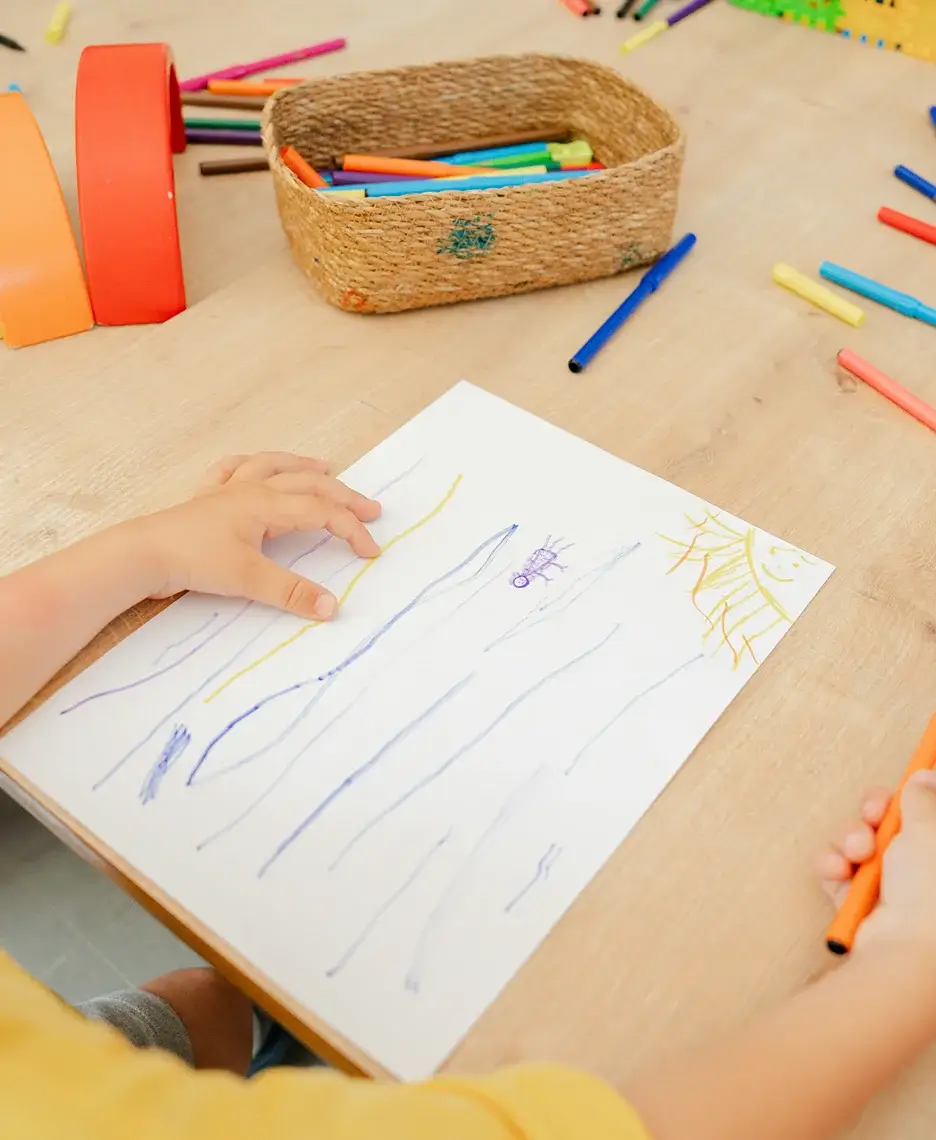
The simplest thing to do is say out loud what is on the page. You don't need to guess what it is. Just notice the colors, the lines and the shapes, the way you might describe a painting in a museum to a friend.
This works for scribbles as well as for drawings with clear people and houses. A toddler's scribble is still full of choices: big or small, dark or light, all over the page or squeezed into one corner.
- "You used a lot of blue at the top."
- "These lines go all the way across the page."
- "Here the color is really dark, and here it is light."
- "You made a big round shape and lots of little dots."
Ask, don't guess
"Is that a dog?" can land badly when it was meant to be Grandma. Instead of guessing, invite your child to tell you. Open questions work best, ones that can't be answered with yes or no.
Some children will tell you a long story about the picture. Some will say "It's just colors" and run off. Both answers are fine. Many young children don't plan a picture before they start, and what it is can change halfway through. Take whatever they give you and don't push for more.
- "Tell me about your picture."
- "What is happening here?"
- "How did you make this part?"
- "Which bit did you like doing most?"
Notice the effort and the process
Comments about how your child worked, rather than how the result looks, tend to be the ones that stick. You might mention how long they kept at it, how they tried something new or how they solved a small problem.
For example: "You kept going until the whole page was green." Or: "You tried the paintbrush and then switched to your fingers." Or: "When the crayon broke, you used the little piece." These are honest observations. They are not about talent, and they don't compare your child to anyone.
Try to avoid comparing siblings' drawings, even kindly. "Your sister's is more colorful" turns art into a contest. If you have more than one child at the table, talk to each one about their own page.
Small things that help
Ask before you write on the drawing, even a name or a label. Some children are happy for you to write what they said about it. Others want the page left exactly as it is. If they say no, write it on the back or on a sticky note.
Give the art somewhere to go. A spot on the fridge, a string with clothespins along a wall or a folder for each child shows that you take the work seriously, without any words at all. Let your child choose which ones go up.
And you don't have to get this right every time. "Good job" will still come out of your mouth on busy evenings, and that is fine. Warmth matters more than finding the perfect phrase. If your child speaks another language at home, use whichever language comes easily to you. If your child has additional needs and drawing is hard or not interesting for them, the same ideas apply to playdough, stickers, stamps or anything else they make.
- Describe one thing you see before saying anything else.
- Ask one open question and wait for the answer.
- Name something about how they worked, not how it looks.
- Let them decide what happens to the drawing next.
Takeaway. When your child shows you a drawing, try describing it, asking about it or noticing how they made it. Your attention is the part they are really asking for, and you can give it in a sentence or two.
This article is general play education for parents. Always supervise children during play. Read the safety notice.